

False Hope
Day nine of the COP26 climate summit is underway, focusing on gender and science and innovation. The UK Government announced a £165 million investment toward progressing gender equality and financing resources and prevention strategies to fight climate change. Almost 50 countries, responsible for over a third of global healthcare emissions, committed to building low carbon and sustainable healthcare systems, which are able to withstand the impacts of climate change. 12 of these countries have set a deadline for 2050, by which they intend for their services to have achieved net zero. Additionally the UK, India, Germany, Canada and UAE are working together to develop new markets for low carbon steel and concrete. The IDDI have committed to the disclosure of the embodied carbon of major public construction by no later than 2025 and achieving net zero in this sector by no later than 2050.
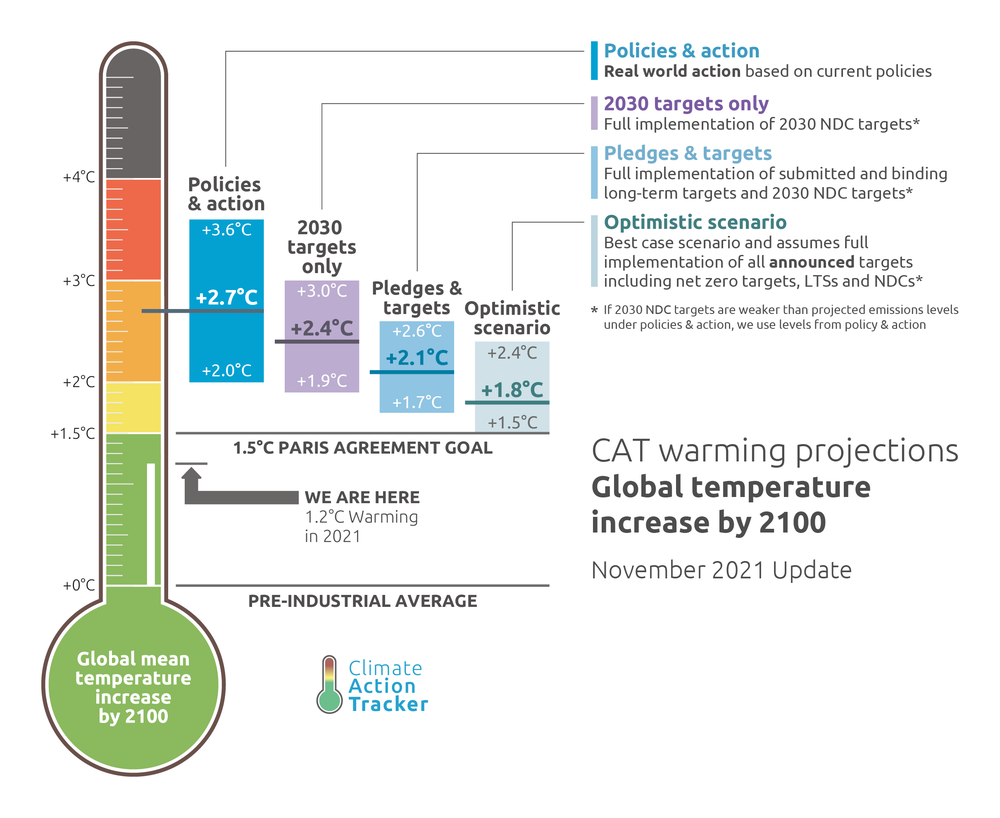
Later, it was addressed that despite the pledges that have been made, the world is still nowhere near its goals of limiting global temperatures. The Climate Action Tracker (CAT) released a report essentially stating that our targets for 2030 are inadequate, that without ambitious goals and action resulting in significant improvement, a 2.4C rise in temperature will be inevitable, predicting a 2.7C climate by 2100, which is almost double the 1.5C goal! Professor Niklas Höhne, founder of the NewClimate Institute, has described this potential reality as “catastrophic climate change,” which would result in far more intense and severe consequences than we have encountered so far, “a situation we can’t handle.” The UK met office warns if global temperatures rise by 2C above pre industrial levels, approximately one billion people could be affected by fatal heat and humidity.
The diagram above is from https://climateactiontracker.org/ depicting the CAT prediction of global temperature increase by 2100. From this website you can also see the global warming report released today, which accuses COP26 of a “massive credibility, action and commitment gap,” contrasting with many of the announcements which were made last week, therefore suggesting that, despite the urgency for action and change, those announcements and commitments may have resulted in false hope.
Written and edited by Sophia Axon and Jasmine Ayres